2.56 Tbps DayZ DDoS Attack: VxShield at Ground Zero
Ground Zero faced a 2.56 Tbps DayZ DDoS attack while protected by VxShield. See how VYKIX combines upstream mitigation with game-aware filtering.
On this page
Ground Zero DayZ hosts its community with VYKIX, protected by VxShield. On 3 July 2026, a UDP flood hit its European endpoint and peaked at 2,564.43 Gbps, about 2.56 terabits per second, and 224.85 million packets per second. It’s the largest attack we’ve documented against a DayZ customer.
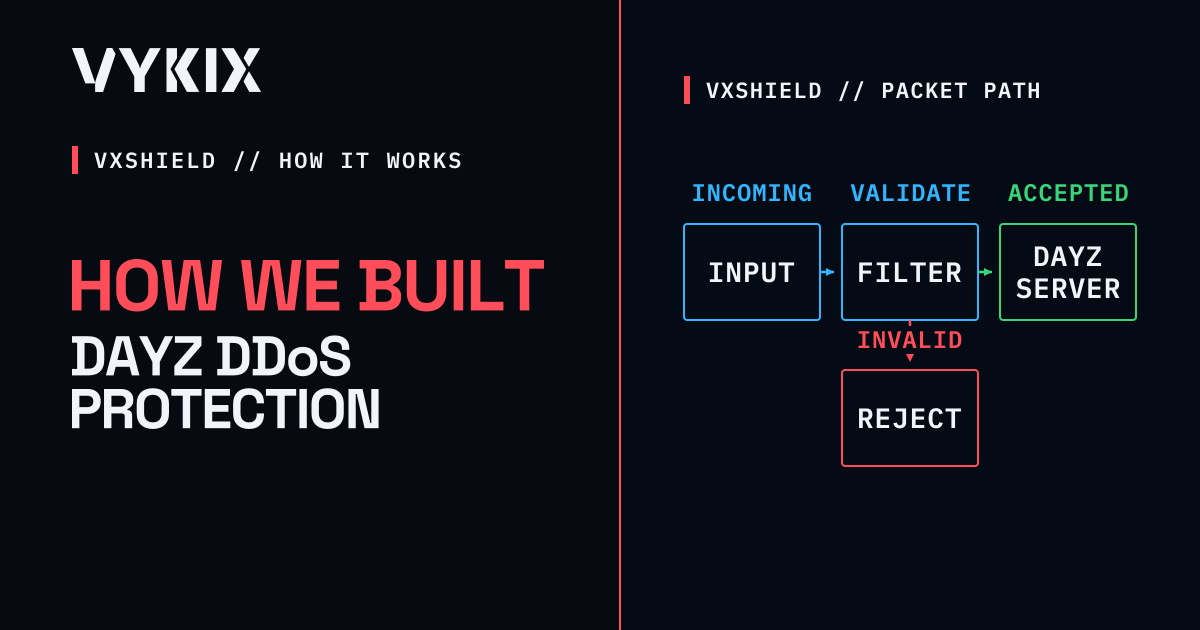
VxShield combines upstream flood mitigation with our own filtering on VYKIX’s network. We check DayZ connections, game packets and server-browser queries before passing traffic to the game server.
The upstream recording counted 18,213 GB of attack traffic and 12.78 billion packets across four minutes and eight seconds, including the quiet period before the flood.
Attack summary
Measurement source: the 46-page mitigation report from Global Secure Layer (GSL), VxShield’s upstream provider. Its figures describe upstream traffic; the VYKIX filter screenshots later in this article are from a separate August recording.
| Metric | Reported value |
|---|---|
| Target | Ground Zero EU endpoint (37.156.35.2/32) |
| Date | 3 July 2026 |
| Start | 20:41:37 UTC |
| Finish | 20:45:45 UTC |
| Report window | 4 minutes, 8 seconds |
| Peak bandwidth | 2,564.43 Gbps |
| Peak packet rate | 224.85 Mpps |
| Total traffic | 18,213 GB |
| Total packets | 12,778.34 million |
| Dominant protocol | UDP, more than 99.99% |
| Main recorded destination port | 27017 |
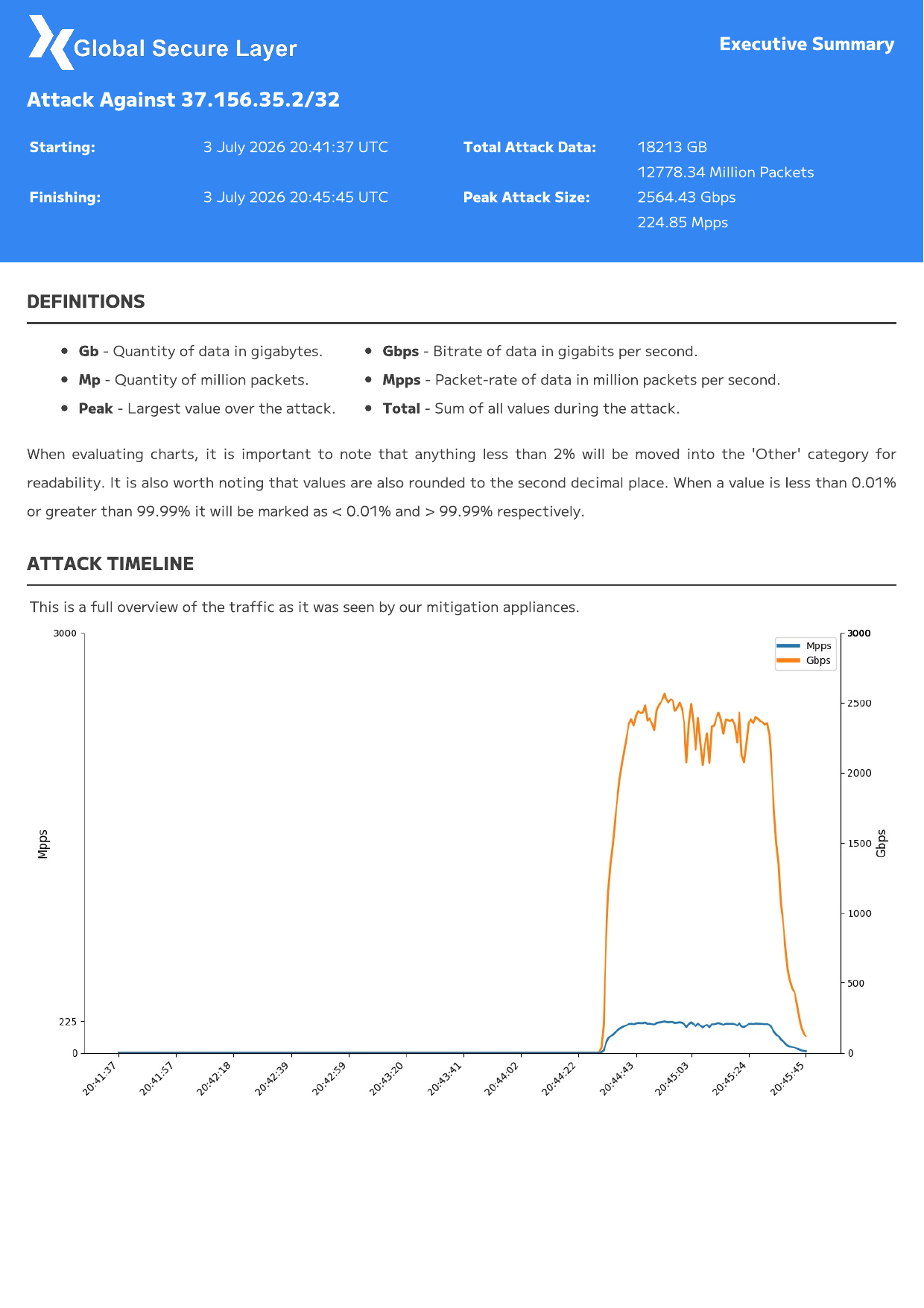 The flood rose to roughly 2.5 Tbps, held near that level and dropped after 20:45 UTC.
The target: Ground Zero’s European DayZ network
Ground Zero runs modded Chernarus servers in Europe and the US. Its public listings describe solo/duo/trio play, group limits and weekend raiding, with more than 20 mods on the listed servers.
The flood targeted 37.156.35.2/32. Ground Zero’s official server list showed the same address for EU1 and EU2 when we checked on 15 September 2026. That links the address to the community; we don’t have July’s server configuration or player counts.
What happened during the 2.56 Tbps attack
Traffic stayed low until about 20:44:22 UTC, then surged. It remained high before dropping near the end of the recording.
The peak figures were 2,564.43 Gbps and 224.85 Mpps. The graph shows the shape of the flood, but we don’t have its raw samples to time how long it held near the peak.
Almost all of the traffic was UDP:
| Protocol | Packet volume | Traffic volume |
|---|---|---|
| UDP | 12,778.29 million packets | 18,212.72 GB |
| ICMP | 0.03 million packets | Less than 0.01 GB |
| TCP | 0.02 million packets | 0.02 GB |
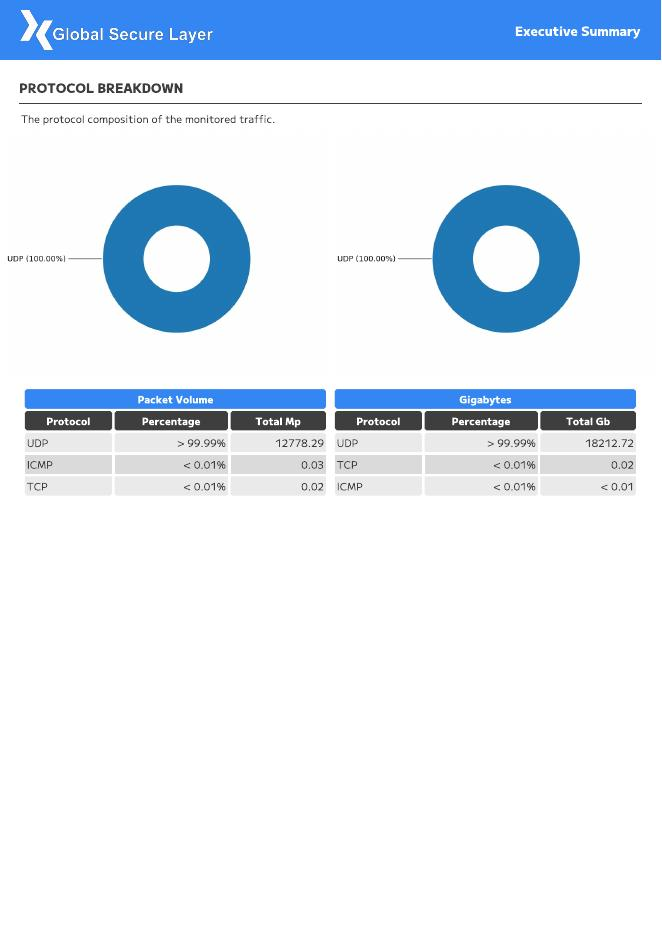 UDP made up more than 99.99% of both the packet count and the traffic volume.
The upstream traffic breakdown groups packets by the country and network of their source IP. Brazil accounted for 25.45% of the gigabytes, Venezuela 7.00% and Mexico 4.95%. UDP source addresses can be faked, so those figures don’t tell us where the attackers were or who owned the machines sending traffic.
VxShield’s upstream layer filtered the flood across 20 named locations, with a further share grouped as Other in the report. Miami handled the largest share at 31.59% of the gigabytes, followed by Frankfurt at 11.96% and Singapore at 9.48%.
Why a DayZ server cannot block this at the origin
A firewall on the game server sees packets after they’ve travelled down its network link. If attack traffic fills that link, the firewall can drop packets but it can’t make room for the players’ traffic that never got through.
The flood has to be handled upstream, on a network with enough capacity to receive it. Ask what happens when that capacity runs out. A provider may blackhole the address, stopping traffic to it to protect the rest of the network. That also takes the target offline.
Bandwidth is only part of the load. At 224.85 Mpps, the filtering equipment also had to process an enormous number of packets each second. A protection plan needs enough packet-processing capacity as well as enough bandwidth.
The DayZ-specific protection problem
A much smaller stream of traffic can cause trouble if each request makes DayZ do work. That work might involve joining the server, handling game packets or answering server-browser queries.
Check the controls for each kind of traffic:
- UDP floods can fill the link or exhaust packet-processing capacity.
- Fake joins make the server handle connections that won’t become players.
- Abusive A2S queries make it answer repeated server-browser requests.
- Forged game packets need checks against the expected exchange and session.
Blocking all UDP would block players too. Filtering has to work with the game and query traffic that the server needs.
How VYKIX approaches DayZ DDoS protection
We handle protection as part of running the DayZ service. VxShield combines network flood mitigation with checks for new connections, game packets and server-browser queries. Those checks address different ways an attacker can put work on the server.
Edge mitigation absorbs the flood
We use VxShield’s upstream mitigation layer to handle floods before they fill the game server’s connection. Our own filtering adds packet and session checks on VYKIX’s network, rejecting traffic that fails those checks before it reaches the game process.
New connections are controlled
We check new connection requests before allowing them to consume the resources of a full session. An established player’s traffic follows different checks from a new connection we haven’t validated yet.
Invalid game traffic is removed early
The filter checks the structure of game packets and whether they fit the session. Sending to the right port, or copying a known packet pattern, isn’t enough to make a connection valid. Rejecting those packets before they reach the game process leaves DayZ with less unwanted traffic to handle.
A2S queries are protected and cached
Players need to find the server as well as join it. For supported DayZ A2S_INFO requests, VxShield answers with cached status information, reducing the number of repeated queries the game server has to handle.
Monitor player joins alongside the listing. A cached reply can keep working while the game process has a problem.
The upstream report lists destination port 27017 without identifying an A2S attack. We protect the query service as part of DayZ hosting, but that port number alone does not classify this flood.
What the DayZ filter telemetry shows
The drop-mix screenshot is dated 4 August 2026. These Amsterdam-edge captures show the DayZ filters at work and are separate from July’s attack report.
DayZ containment rate
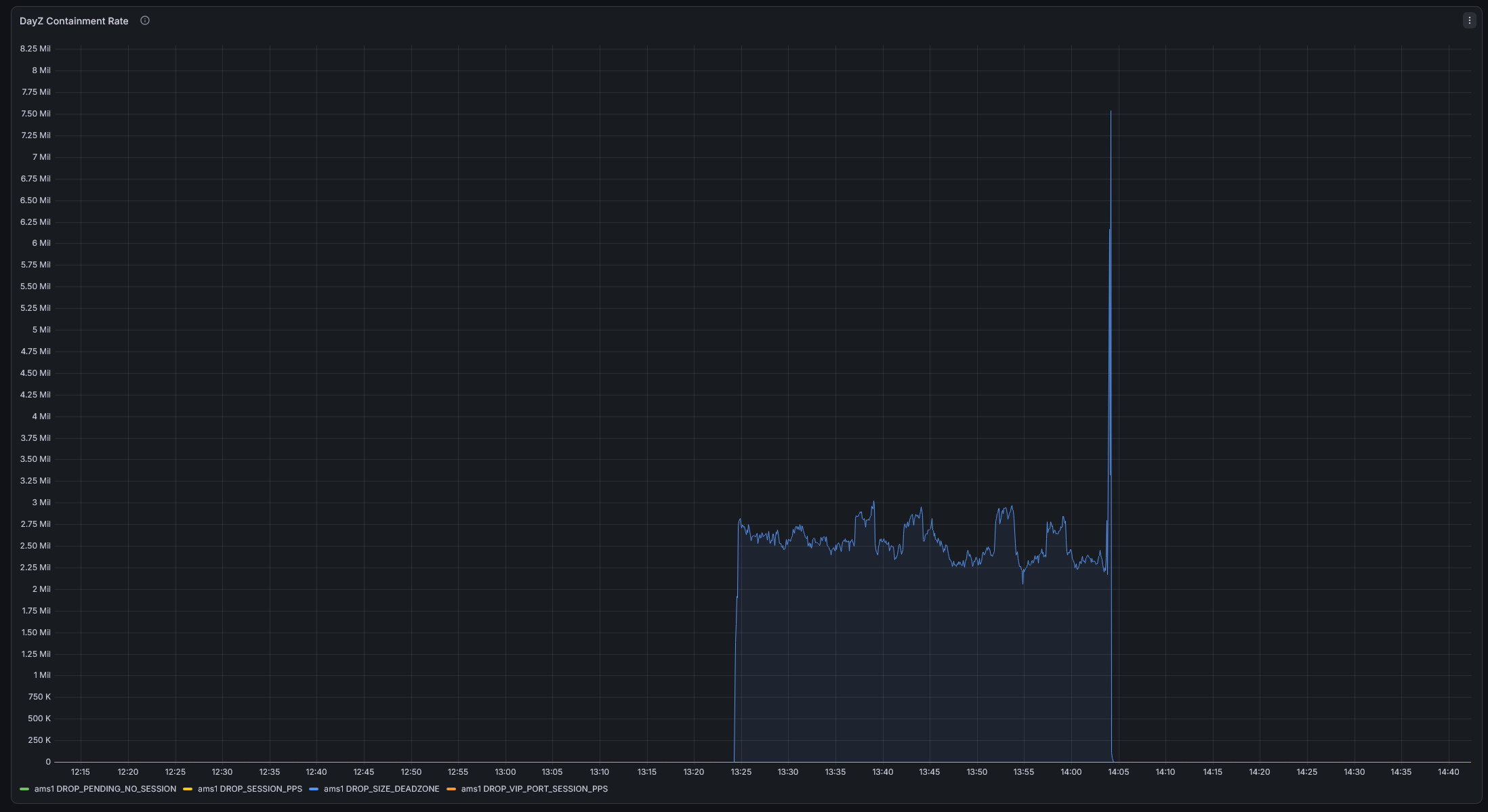 On the Amsterdam edge,
 DROP_SIZE_DEADZONE accounts for the sustained activity from about 13:25 to 14:05.
The chart sits around 2.3 million to 3 million, then spikes above 7.5 million near the end. The named counter lets us track this DayZ filter without mixing it into all network drops. Read the numbers as filter counters, not bandwidth or player counts.
Drop reasons stay visible
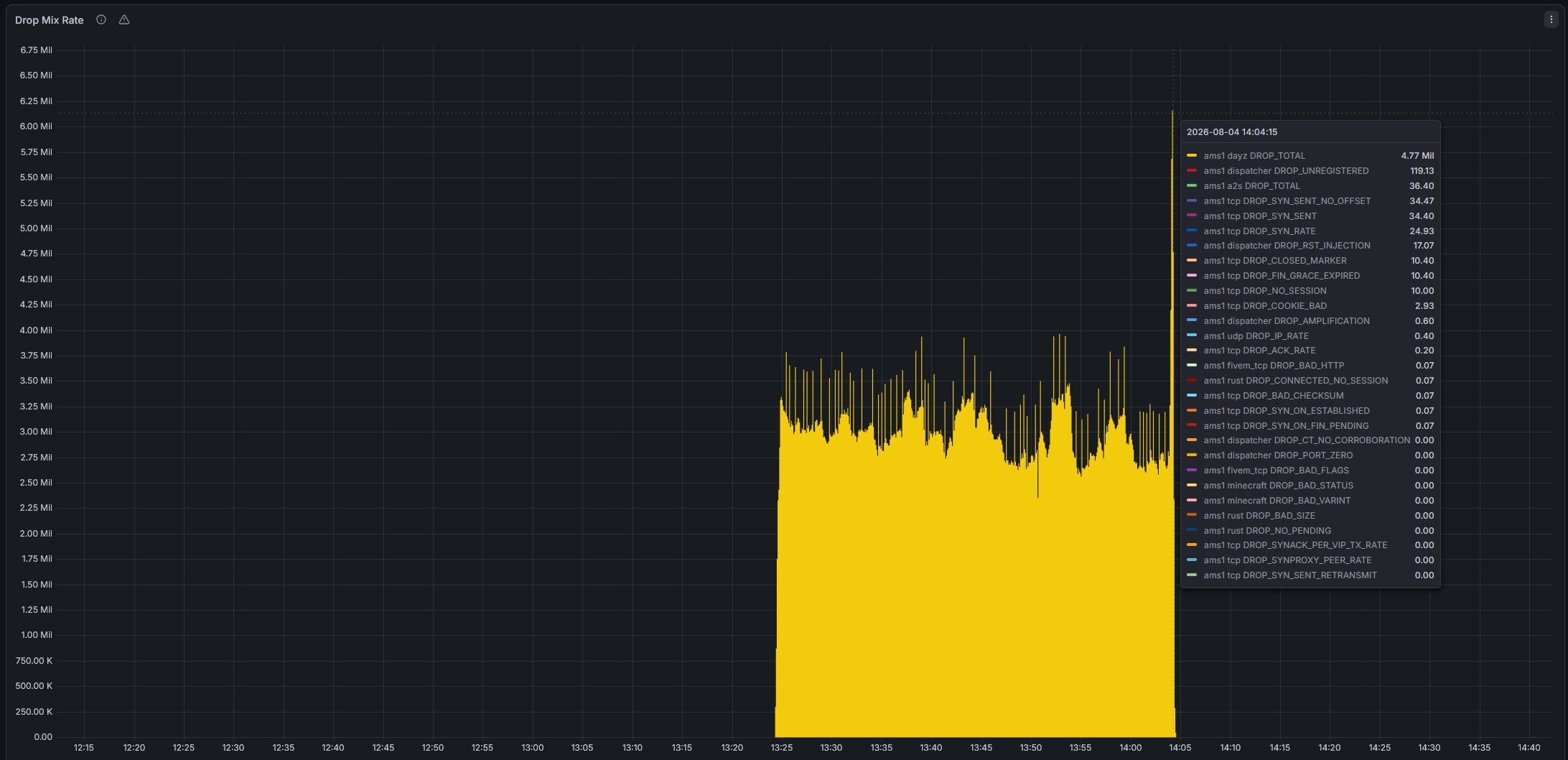 At 14:04:15,
 dayz DROP_TOTAL reads 4.77 million. The other lines show drops from separate protocol and game filters.
Separate A2S, TCP, UDP, dispatcher and game counters let an engineer see which filter is doing the work and investigate that path.
Session proof and ACK outcomes
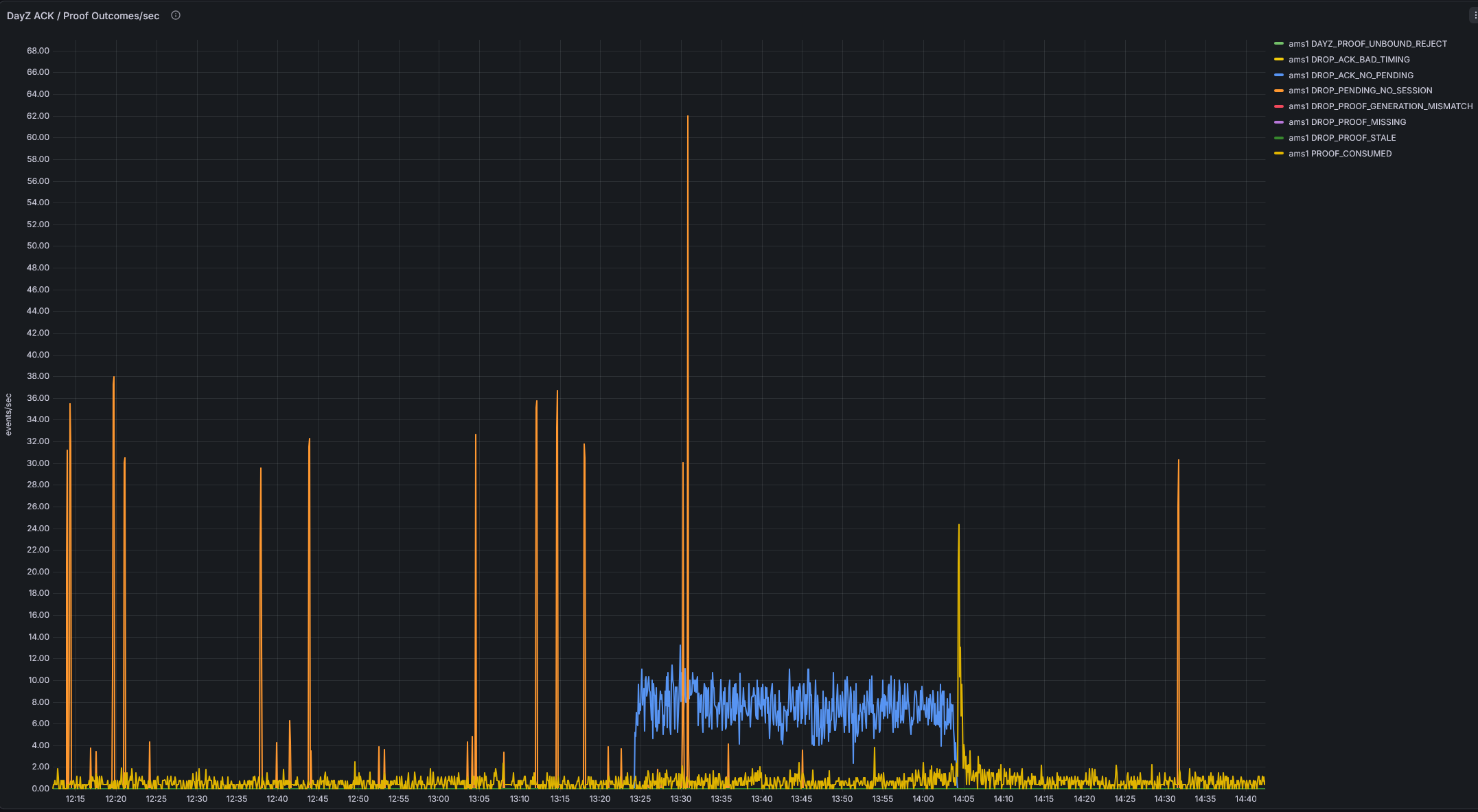 The Amsterdam edge breaks down DayZ connection decisions, including ACK and session-proof outcomes.
You can follow those decisions through DROP_ACK_NO_PENDING, DROP_PENDING_NO_SESSION, DROP_ACK_BAD_TIMING, DROP_PROOF_MISSING, DROP_PROOF_STALE and PROOF_CONSUMED.
A packet might arrive on the right protocol and port with no pending session, an expired proof or timing that doesn’t fit the exchange. These counters help us tell those cases apart while investigating the filter.
Did players stay connected?
The July graphs show the traffic handled by VxShield’s upstream layer. They don’t tell us whether players disconnected. We’d need game-server logs, player-session records and uptime monitoring from that period to check that, and those aren’t included in the report.
Lessons for DayZ server owners
Ask for both Gbps and Mpps capacity
Ask how the provider handles a flood that fills its link or reaches its packet-processing limit. Find out whether it would blackhole your address and which measurements you’d receive after the incident.
Confirm that protection covers the DayZ traffic path
Have the provider explain how it protects player joins, game packets and A2S queries, and how it keeps unwanted traffic away from the game server. Confirm that those controls are enabled for the product and profile you’re buying.
Treat server-browser availability as part of uptime
Test whether players can find the server and whether they can join it. Record both results so you can distinguish a missing listing from a game connection problem.
Save the game logs with the traffic graphs
Save the target address, timestamps, units, peaks, totals and protocol breakdown alongside the game-server logs for the same period. That gives you a way to compare the flood with what happened to players.
Common questions
How large was the DDoS attack against Ground Zero DayZ?
The flood peaked at 2,564.43 Gbps, about 2.56 Tbps, and 224.85 million packets per second. VxShield’s upstream report covers 20:41:37 to 20:45:45 UTC on 3 July 2026, including the quiet period before the flood.
Was this the largest DayZ DDoS attack ever recorded?
It’s the largest attack we’ve documented against a DayZ customer. There is no complete public register of DayZ attacks that would let us call it a world record.
What type of attack hit the DayZ server?
UDP made up more than 99.99% of the traffic: 12,778.29 million packets and 18,212.72 GB. The upstream report did not identify it as an A2S attack; the destination port by itself cannot tell us that.
What should DayZ DDoS protection cover?
Ask how the host filters floods, handles packet volume and checks new connections, game packets and A2S queries. To check whether players stayed connected during an attack, compare the traffic graphs with game-server and player-session logs.
Does A2S query caching protect a DayZ server?
Yes, caching supported A2S_INFO replies reduces the server-browser queries DayZ has to answer. The host still needs to protect game traffic and joins upstream. Test a player connection too, because a cached reply can work while the game process has a problem.
Protect your DayZ server before the next attack
DayZ hosting from VYKIX includes VxShield, DayZ traffic checks and supported A2S query caching. Check the selected plan’s total, including VAT and unavoidable fees, in the live portal.
Moving an existing community? Ask us to check the migration first. Our switcher offer adds seven days to an eligible paid plan and includes best-effort help with the move once we’ve agreed on its scope. Terms apply.
See DayZ server hosting plans | Read the DayZ DDoS protection guide | Visit Ground Zero DayZ
Game-aware DDoS protection for your server.
Bring your community to VYKIX with VxShield protection included.